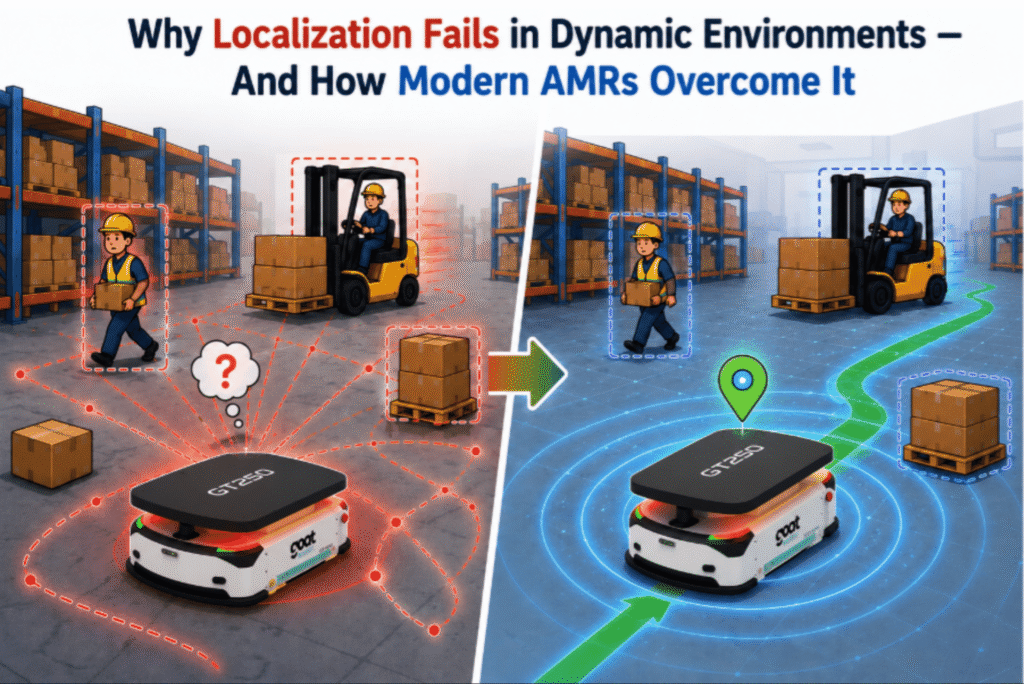
Autonomous Mobile Robots (AMRs) are increasingly being deployed across manufacturing, warehousing, and logistics to improve material movement, operational efficiency, and productivity. Unlike Automated Guided Vehicles (AGVs), which typically rely on fixed guidance paths, AMRs can navigate through changing environments using technologies such as LiDAR, cameras, and odometry to build or reference a digital map of their surroundings.
This ability to navigate autonomously depends on something fundamental: AMR localization.
Localization allows a robot to estimate its position and orientation, or pose, within an environment. It is closely connected to navigation, path planning, docking, pallet pickup, and fleet coordination. When localization becomes unreliable, these functions can also be affected, potentially leading to navigation drift, failed missions, downtime, productivity losses, and increased safety risks.
The challenge becomes significantly harder when the environment is constantly changing.
Why Localization Becomes Difficult in Industrial Environments
A factory or warehouse is rarely a static environment.
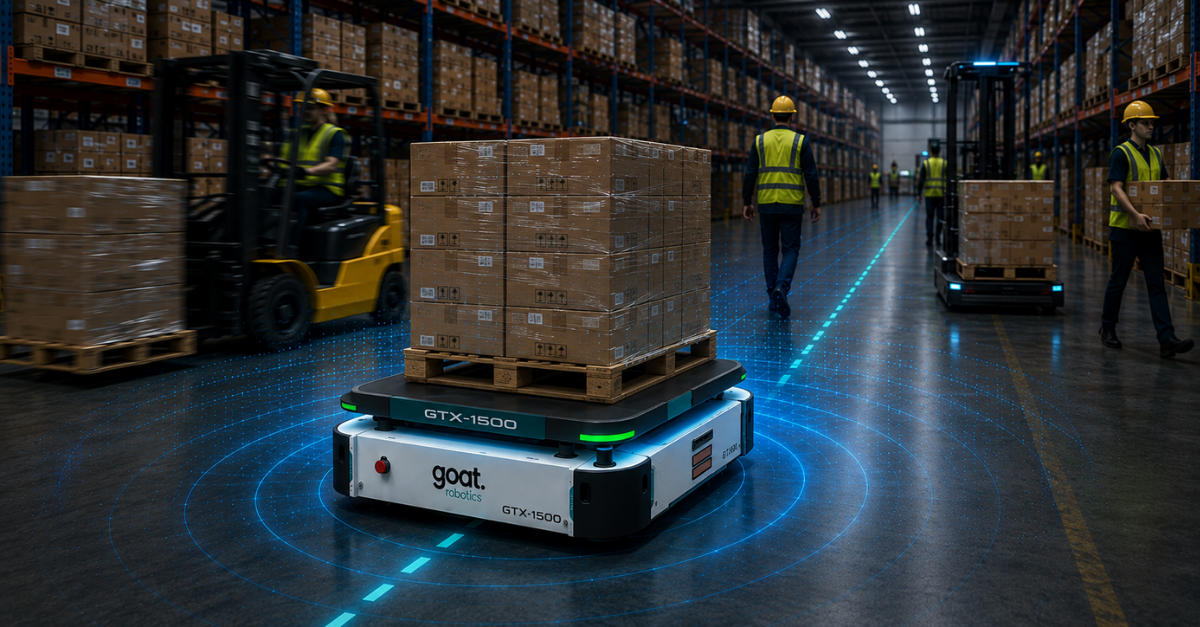
During a typical operating shift, forklifts move through aisles, workers cross robot paths; pallets are relocated, inventory positions change, and temporary obstacles appear and disappear. Even environmental conditions such as lighting can vary throughout the operation. A pallet that was present a few minutes ago may no longer be there when an AMR passes through the same location.
For an AMR localization system, these changes matter because the robot relies on sensor observations to understand where it is within its environment.
In controlled environments, relatively stable features can provide consistent references for localization. In a busy industrial facility, however, some of the features observed by the robot may be temporary. This creates a fundamental challenge: the robot must determine which observations represent the permanent structure of the environment and which are simply the result of objects moving through it.
This is one of the reasons maintaining accurate localization in dynamic industrial environments is significantly more challenging than operating in controlled or static environments.
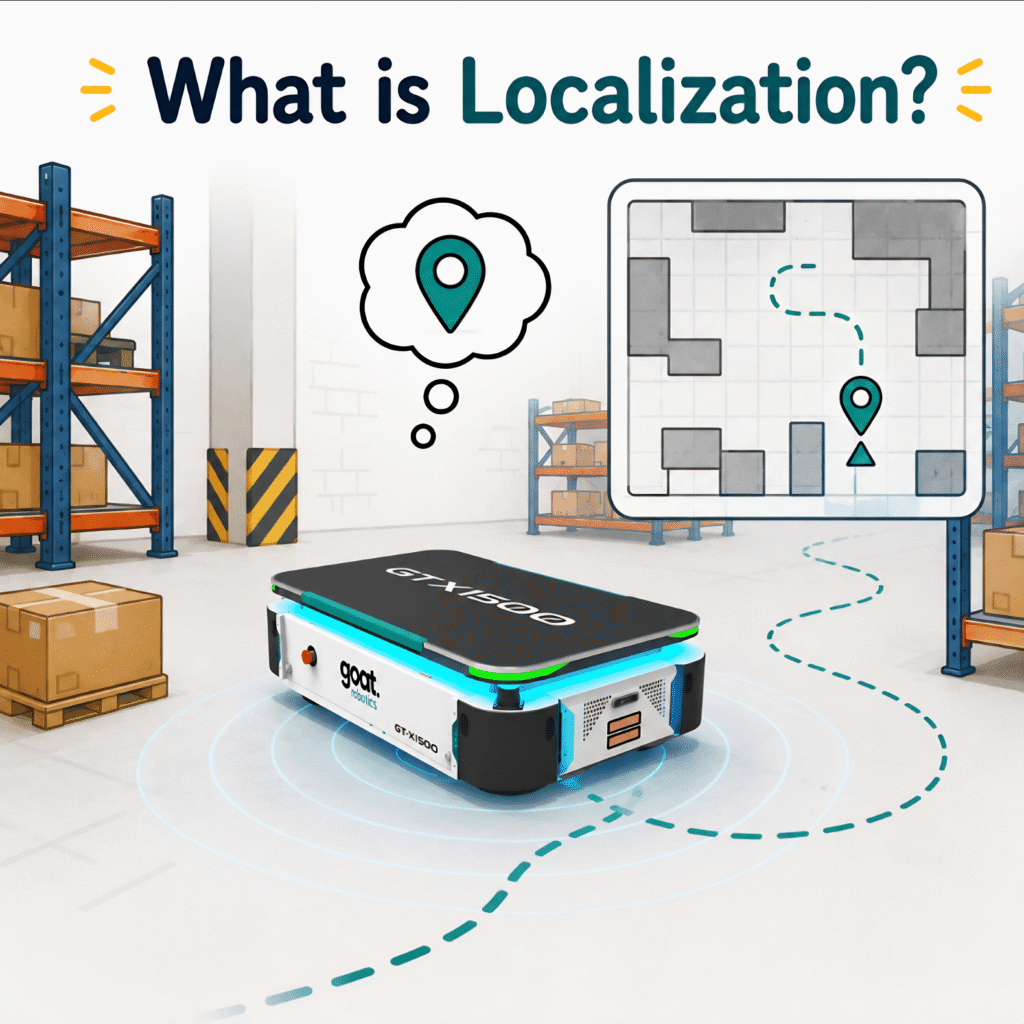
AMR localization must remain reliable even as industrial environments continuously change.
How Dynamic Objects Can Cause Localization Drift
AMRs rely on multiple sensing inputs to estimate their position. LiDAR provides information about the surrounding geometry, odometry provides movement-related information, and IMUs contribute inertial measurements. These sensor inputs are processed by localization algorithms to estimate the robot’s current pose.
The difficulty arises when dynamic objects become part of these observations.
A moving forklift, worker, or recently relocated pallet may appear clearly in a sensor scan, but it does not necessarily represent a permanent feature of the environment. If transient observations are treated in the same way as stable structural features, they can reduce the reliability of scan matching and pose estimation.
Over time, these inaccuracies can accumulate as localization drifts. Even relatively small errors can affect goal pose accuracy, docking, pallet pickup, and coordinated fleet operation. In a crowded industrial environment, prolonged localization degradation can ultimately affect both operational performance and safety.
The engineering challenge is therefore not simply to collect more sensor data. It is to determine which sensor observations can be trusted for localization.
Why AMR SLAM Faces Challenges in Dynamic Environments
Simultaneous Localization and Mapping (SLAM) allows a robot to build or reference a map while estimating its position within that environment. For AMRs, SLAM and localization form an important part of the autonomous navigation stack.
However, dynamic industrial environments challenge the assumptions behind conventional approaches. The source identifies moving workers, forklifts, pallet movements, changing layouts, and other environmental variations as factors that can affect the consistency of sensor observations.
Consider an AMR moving through a warehouse aisle. A fixed wall or structural pillar can provide a relatively stable reference. A forklift moving through the same aisle cannot be treated in the same way. The robot therefore needs to distinguish between persistent environmental structure and transient objects.
This distinction is becoming increasingly important as AMRs move from controlled environments into large-scale industrial operations where people, vehicles, inventory, and robots continuously share the same workspace.
The result is a shift in focus—from simply performing localization to building a localization system that can remain reliable despite environmental uncertainty.
Modern Approaches to Reliable AMR Localization
To maintain accurate pose estimation in dynamic environments, modern AMR systems increasingly combine several complementary approaches rather than relying on a single sensing or localization method.
These include multi-sensor fusion, perception and filtering, scan matching and pose estimation, adaptive mapping, and robust localization pipelines. Together, these layers help the robot maintain a more reliable understanding of its position even when environmental conditions change.
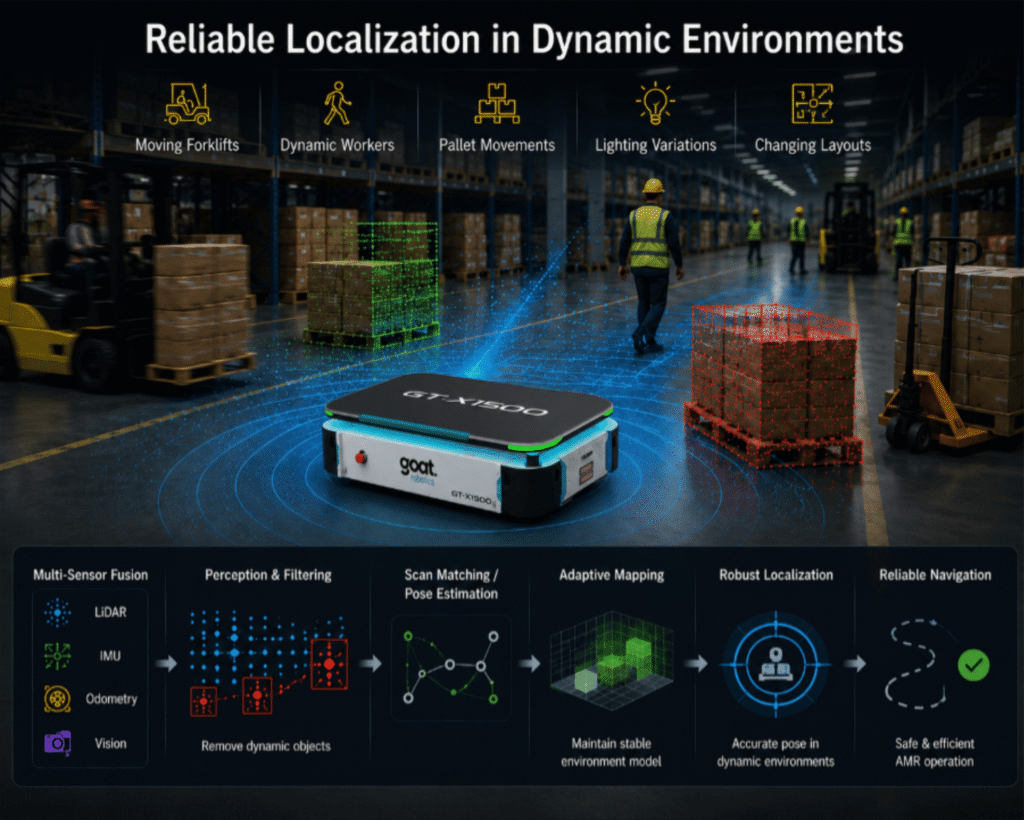
A modern AMR localization pipeline combines sensor fusion, perception filtering, pose estimation, adaptive mapping, and robust localization to support reliable navigation in dynamic environments.
A modern AMR localization pipeline combines sensor fusion, perception filtering, pose estimation, adaptive mapping, and robust localization to support reliable navigation in dynamic environments.
Multi-Sensor Fusion: Combining Complementary Data
Modern AMRs increasingly use sensor fusion to improve localization reliability. Rather than depending on a single sensing modality, the system can combine information from LiDAR, IMUs, wheel odometry, and vision sensors. Each provides a different perspective of the robot’s movement and surroundings, allowing the localization system to compensate when one source becomes temporarily unreliable.
The source identifies techniques such as Extended Kalman Filters (EKF), factor graph optimization, and probabilistic estimation as approaches that can be used to combine and optimize these measurements. This can support more stable pose estimation during temporary feature loss, rapid motion, or partial environmental occlusion.
The objective is not simply to collect more data. It is to create a more reliable estimate by combining complementary sources of information.
Dynamic Object Filtering: Separating Stable Features from Temporary Objects
One of the most important challenges in industrial AMR localization is distinguishing permanent structural features from temporary objects.
A worker, forklift, or pallet may appear in a sensor scan, but these objects can move before the robot encounters the same area again. Treating these transient observations as stable references can introduce inconsistency into the localization process.
Modern navigation pipelines therefore incorporate dynamic object filtering techniques to suppress transient observations and prioritize relatively stable features such as walls, pillars, and fixed infrastructure.
This allows the localization system to focus more heavily on environmental features that are useful for maintaining a consistent estimate of the robot’s pose.
In practical terms, the system needs to answer a simple but critical question continuously:
Is this something the robot should use as a reference, or is it something that is moving through the environment?
Adaptive Mapping: Maintaining a Stable Environmental Model
Dynamic environments also create challenges for the robot’s representation of its surroundings.
If the physical environment changes, the localization system needs to remain robust without allowing temporary changes to unnecessarily destabilize the underlying environmental model. This is where adaptive mapping becomes part of the broader localization architecture.
Rather than treating every new observation as equally important, the system can work toward maintaining a stable representation of the environment while accounting for changing observations.
This becomes particularly relevant in warehouses and factories where inventory positions, temporary obstructions, and operational conditions can change continuously.
Robust Localization: Maintaining Reliability When Conditions Degrade
Even with sensor fusion, filtering, and adaptive mapping, localization can temporarily become uncertain. A robust AMR navigation pipeline therefore needs mechanisms to identify and manage degraded conditions.
The source identifies several elements that contribute to this architecture, including sensor preprocessing, outlier rejection, scan matching optimization, pose confidence estimation, and automatic relocalization strategies.
Sensor preprocessing prepares incoming measurements for further processing, while outlier rejection helps reduce the influence of inconsistent observations. Scan matching optimization supports alignment between current sensor observations and environmental representation. Pose confidence estimation provides an indication of how reliable the current localization estimate is, while automatic relocalization strategies can support recovery when tracking becomes temporarily degraded.
Together, these mechanisms help transform localization from a single estimation step into a more resilient process capable of operating continuously in changing industrial environments.
From Localization to Reliable Autonomous Navigation
The ultimate purpose of all these techniques is not simply to produce an accurate coordinate.
Reliable AMR localization enables the robot to understand where it is well enough to make dependable navigation and operational decisions. When localization remains stable, the robot can execute missions, approach docking positions, perform pallet pickup, coordinate with other fleet members, and navigate through shared industrial spaces with greater consistency.
As factories become more dynamic, the localization problem becomes increasingly connected to the overall autonomy architecture. Sensor fusion provides complementary measurements. Dynamic object filtering helps separate temporary objects from stable references. Scan match and pose estimation to convert observations into positional information. Adaptive mapping helps maintain an environmental model, while robust localization mechanisms help the system respond when conditions become uncertain.
These are not isolated technologies. They are layers of a larger system designed to keep autonomous navigation reliable.
Conclusion — Building AMRs That Can Localize in the Real World
Reliable localization is a fundamental capability for Autonomous Mobile Robots operating in industrial environments. Navigation, obstacle avoidance, task execution, docking, pallet pickup, and fleet coordination all depend on the robot maintaining a reliable estimate of its position and orientation.
The difficulty is that real factories and warehouses are constantly changing. Workers move, forklifts operate; pallets are relocated, layouts evolve, and environmental conditions vary. These changes challenge localization systems that depend heavily on consistent environmental observations.
Modern AMR localization therefore increasingly relies on resilient architectures built around sensor fusion, dynamic object filtering, adaptive mapping, scan matching, pose confidence estimation, and relocalization.
The objective is not to eliminate the complexity of dynamic environments. It is to build localization systems capable of understanding and operating within that complexity.
As autonomous mobile robots move into increasingly demanding industrial applications, reliable localization will remain one of the foundations of safe, efficient, and dependable autonomous robot navigation.