
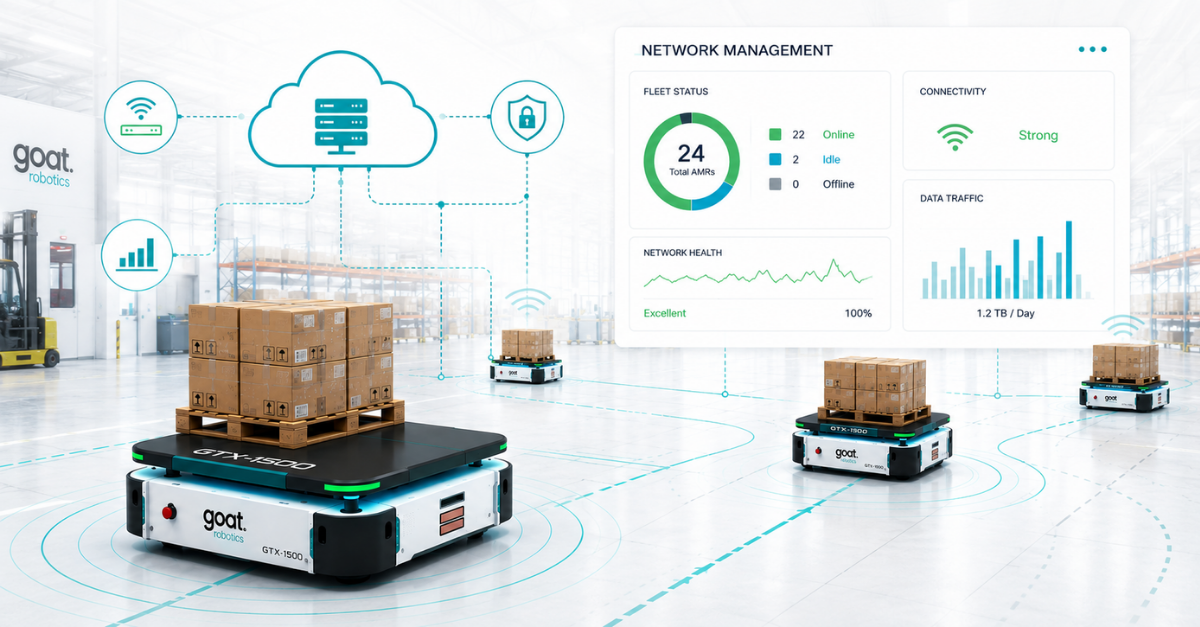
AMR Network Management: Why Industrial Robot Fleets Depend on the Network
How latency, wireless connectivity, fast roaming, middleware, and network security determine the reliability of AMR deployments
An Autonomous Mobile Robot (AMR) may have capable sensors, sophisticated navigation algorithms and powerful onboard computing, but none of these capabilities operate in isolation. Every command, status update, fleet coordination message and monitoring signal depends on the communication network connecting the robot to the rest of the system.
This is why network management is often an overlooked but critical part of AMR deployment.
A robot can perform reliably in a controlled laboratory environment and still behave unpredictably once it enters a busy factory or warehouse. Commands may arrive late; navigation may stall during movement, or communication may temporarily disappear as the robot moves between wireless access points. In an industrial environment, these are not merely IT problems. They can directly affect operational reliability and safety.
The network therefore needs to be engineered alongside the robot mechanical, electrical and software systems—not treated as an infrastructure task to be completed just before deployment.
The Network Behind Every AMR Deployment
A fixed production machine typically communicates through a wired connection. An AMR has a different operating model: it continuously moves through the facility while maintaining communication with fixed infrastructure and other systems.
That wireless connection carries several types of information simultaneously. Real-time control messages need to reach the robot with minimal delay. Fleet coordination messages allow multiple robots to share tasks and operate within common spaces. Monitoring data provides operators with information such as battery state, task progress, motor temperatures, and sensor health.
The consequence is straightforward: when the communication path becomes unreliable, the behaviour of the AMR can become unreliable as well.
The source highlights several useful deployment reference points: local LAN latency in the 1–5 ms range, fast roaming handoffs below 50 ms, significantly higher latency when communication is routed through the internet, and a minimum Wi-Fi security baseline of WPA2. These values should be validated against the actual deployment architecture before publication or implementation.
Getting the network right is not a final step before deployment. It needs to be designed from the start — the same way you design the power system or the mechanical frame.

What Does an AMR Network Actually Carry?
The network supporting an AMR is more than a connection for remote monitoring.
During operation, real-time control information may include commands and signals where communication delay can affect physical robot behaviour. In a multi-robot environment, fleet coordination becomes equally important because robots share workspace, tasks, and operational information.
At the same time, the same network carries telemetry and monitoring information. Battery state, task progress, motor temperature and sensor health need to reach the monitoring system with sufficient continuity to provide an accurate picture of fleet operation.
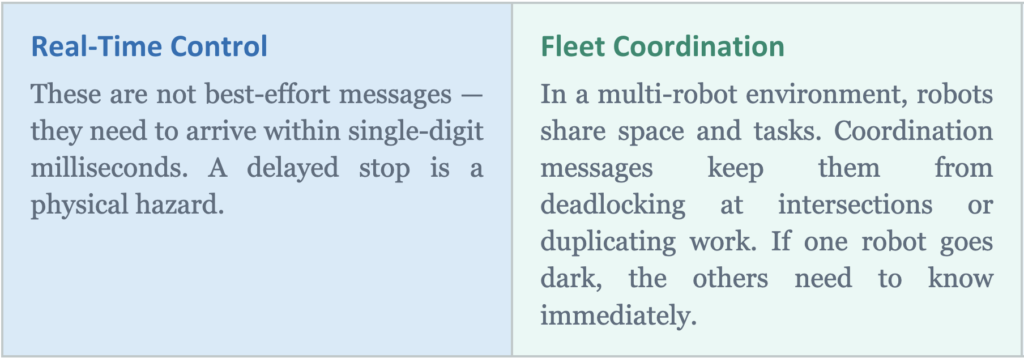
This creates a fundamental engineering requirement: the wireless infrastructure needs to support both robot mobility and continuous communication.
Where AMR Network Deployments Go Wrong
Most AMR network problems are not caused by exotic technologies. They usually originate from a small number of predictable failure points.
An AMR can experience unreliable wireless connectivity, slow access-point handoffs, incorrect network-interface selection in communication middleware, unsecured command channels or excessive latency caused by routing control traffic through the cloud.
Each failure has a different mechanism, but the operational consequence can be similar: communication becomes unreliable at exactly the moment the robot needs it.
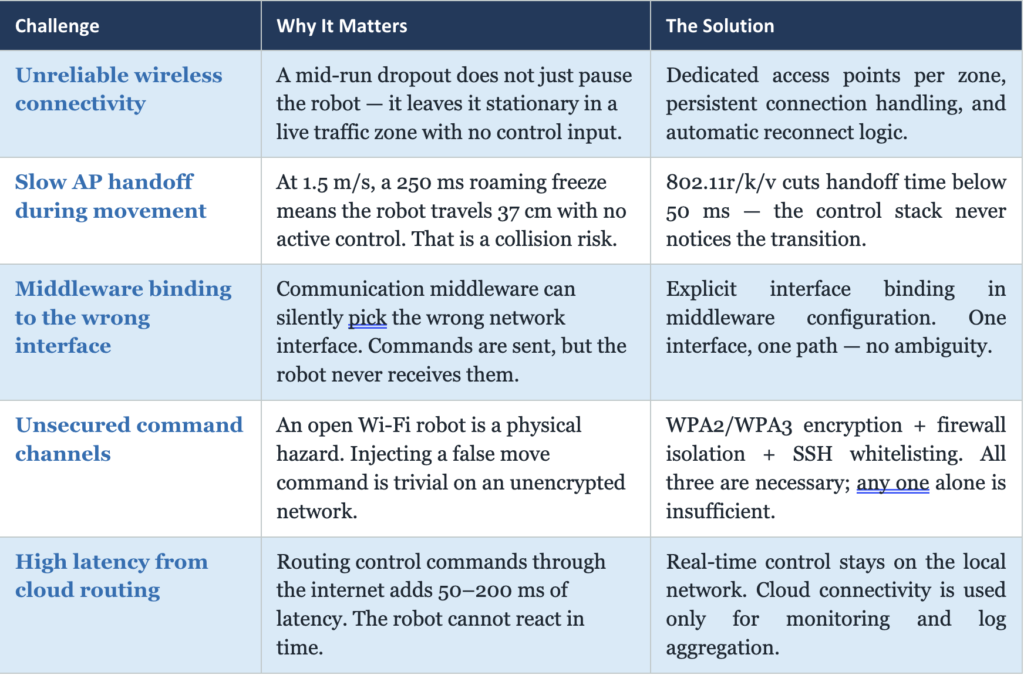
None of these problems are individually difficult to fix. The challenge is that all of them need to be addressed. Miss one layer and it becomes the weakest link in the entire system.
The important point is that these are not isolated configuration details. The network behaves as a system, and the weakest layer can affect the reliability of everything above it.
Network Latency Is a Safety and Performance Metric
Latency is often treated as a conventional network-performance measurement. For mobile robotics, its significance is more direct because communication delay can translate into physical movement.
Consider an AMR travelling at 1.5 m/s. A 50 ms delay means the robot travels approximately 7.5 cm during that interval. In a facility containing workers, forklifts, and narrow aisles, that distance can become operationally significant.
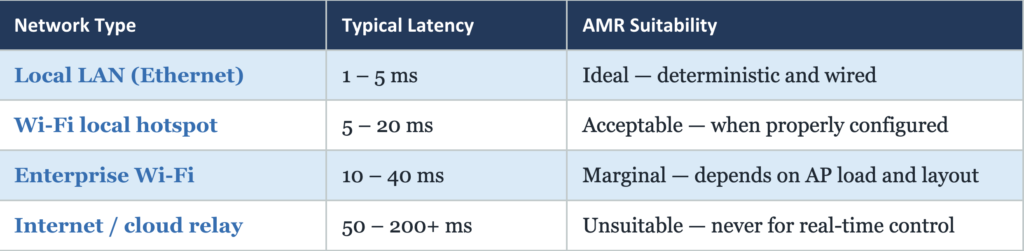
Internet-routed control is not a fallback option — it is not an option at all. If a deployment requires real-time robot control through a cloud relay, the network architecture needs to be redesigned before anything else.
The source compares different communication paths:
This leads to an important architectural principle: real-time AMR control should remain within the local communication environment, while cloud connectivity can be used for monitoring, logging, analytics, and other non-real-time workloads.
The exact latency requirements, however, should be validated against the robot’s control architecture and safety system rather than treated as universal thresholds.
Fast Roaming: Keeping AMRs Connected While They Move
A warehouse or factory may require multiple wireless access points because a single AP cannot provide reliable coverage across an entire facility. As an AMR moves through the environment, it therefore needs to transition between access points without creating a communication gap.
With conventional roaming, the transition can involve authentication and connection procedures that temporarily interrupt communication. The source identifies a potential 200–300 ms interruption as a significant concern for moving AMRs.
This is where the 802.11r/k/v family becomes relevant.
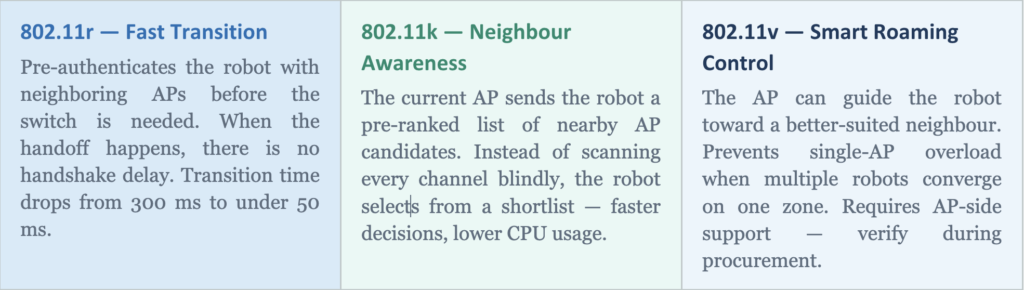
802.11r — Fast Transition
802.11r allows the robot to establish the necessary trust relationship with neighbouring access points before the actual transition. This reduces the authentication of overhead during handoff.
The source reports that well-configured deployments can reduce transition times substantially, with the target being below 50 ms. Actual performance should be measured on the deployed infrastructure.
802.11k — Neighbour Awareness
Without neighbour awareness, a device may need to scan available channels to identify suitable access points. 802.11k allows the current AP to provide information about neighbouring candidates, helping the robot make a faster roaming decision.
This can be particularly useful in environments with closely spaced access points and high robot density.
802.11v — BSS Transition Management
802.11v allows the network to influence roaming decisions by recommending a more suitable neighbouring AP. This can help distribute devices when one access point becomes heavily loaded.
Together, 802.11r, 802.11k and 802.11v can form an important part of an industrial Wi-Fi architecture designed for mobile robots. However, support needs to be verified across the actual AP and robot hardware rather than assumed from a vendor specification sheet.
# Step 1: Stop automatic Wi-Fi management
sudo systemctl stop NetworkManager
# Step 2: Identify the Wi-Fi interface name
iw dev
# Step 3: Bring the interface down
sudo ip link set wlan0 down
# Step 4: Switch to monitor mode
sudo iw dev wlan0 set type monitor
# Step 5: Bring the interface back up
sudo ip link set wlan0 up
# Step 6: Capture beacon frames
sudo tcpdump -i wlan0 -s 0 -vvv type mgt subtype beacon -w beacons.pcap
Middleware and Container Networking: The Hidden Communication Layer
The wireless infrastructure is only one part of the communication path. The robot software stack also needs to use that network correctly.
Modern AMR software often relies on communication middleware for message discovery, delivery and routing between software components. When a robot has multiple network interfaces—such as Wi-Fi, Ethernet and loopback—automatic interface selection can create unexpected behaviour.
For example, middleware may attempt discovery across multiple interfaces, resulting in duplicate messages, failed discovery or time-critical communication being routed through an unintended path.
Explicitly binding the middleware to the intended interface removes this ambiguity.
The same principle becomes important when AMR software is containerized.
Docker’s default bridge networking creates a virtual network layer. According to the source, this can interfere with UDP multicast-based discovery used by communication middleware. Software nodes may start successfully while remaining unable to discover one another.
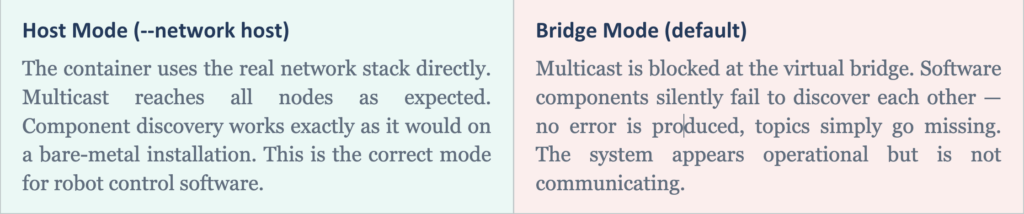
Bridge mode does not throw an error. Processes start, nodes launch, and nothing obviously breaks — until you notice that commands are being sent but the robot is not responding. Always use host networking for containerised robot control software.
With host networking (–network host), the container uses the host network to stack directly, allowing multicast communication to behave more like a bare-metal deployment. The appropriate networking mode should ultimately be validated against the specific middleware, container architecture, and security requirements of the AMR system.
The important lesson is that network reliability isn’t determined only by the access point. It extends through the entire stack:
Wireless infrastructure → network interface → middleware → container → robot application.
AMR Network Security: Protecting a Physically Connected Robot
Network security has an additional dimension in robotics.
An unsecured computer network can expose data. An unsecured AMR network can potentially expose physical control systems.
That makes security part of the robot’s operational architecture rather than simply an IT requirement.
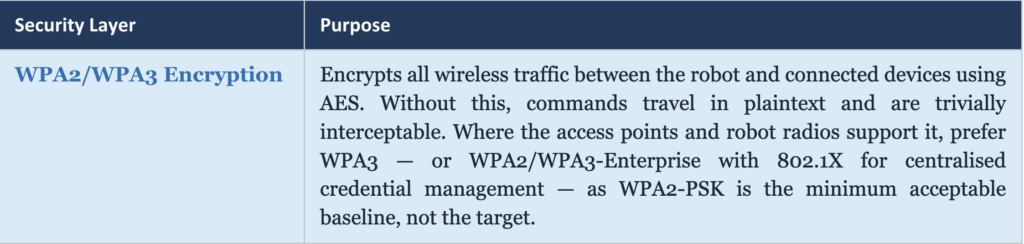
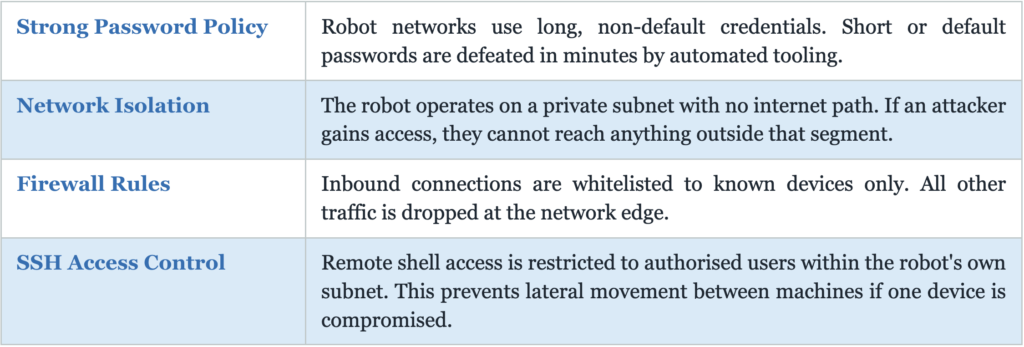
The source proposes a layered security model combining wireless encryption, network isolation, firewall controls, and restricted SSH access.
WPA2/WPA3 Encryption
Wireless traffic should be protected against interception. The source identifies WPA2 as a minimum baseline and recommends stronger WPA3 or enterprise authentication where supported.
Network Isolation
The robot network should be separated from unnecessary external networks and services. This limits what an attacker can access if a device or credential is compromised.
Firewall Rules
Inbound communication should be restricted to known and required systems rather than exposing unnecessary services.
SSH Access Control
Remote shell access should be limited to authorized users and appropriate network segments to reduce the possibility of lateral movement.
These layers address different parts of the attack surface. Encryption protects communication over the wireless medium; network isolation limits reachability, and access controls restrict system-level access.
How to Verify an AMR Network Before Deployment
Network specifications on paper do not necessarily guarantee behaviour on the factory floor.
An access point may claim support for 802.11r/k/v, but the feature may not be enabled or configured as expected. The source therefore recommends independently verifying the infrastructure before AMRs enter production.
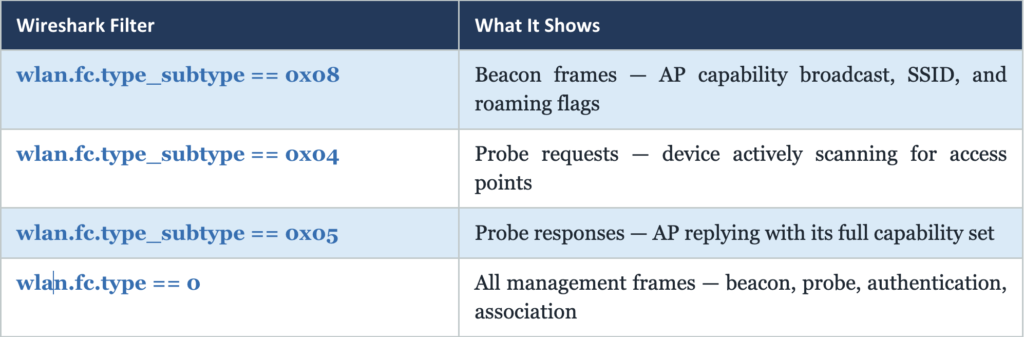
One approach is to place a compatible Wi-Fi adapter into monitor mode and capture beacon frames from the access points. These frames can then be inspected using a packet-analysis tool such as Wireshark.
The source specifically identifies the following indicators:
Mobility Domain (MDIE) — associated with 802.11r
Radio Measurement — associated with 802.11k
BSS Transition Management — associated with 802.11v
Conclusion: Design the Network Before the Robot Hits the Floor
AMR deployments often involve months of engineering to work across mechanical systems, sensors, navigation algorithms, and software. Yet the network supporting those systems can sometimes be treated as an infrastructure detail to be resolved later.
That approach creates unnecessary risks.
Latency, wireless roaming, middleware configuration, container networking, and security are all parts of the same communication architecture. Each has a defined role, and each needs to be considered before production deployment.
The network is not simply the infrastructure around the AMR. It is part of the AMR system itself.
The most reliable approach is therefore simple: Design the network. Configure it deliberately. Verify it independently. Then deploy the robots.
Because once an AMR fleet is operating in production, diagnosing a network problem becomes significantly more disruptive than solving it before the first robot enters the facility.