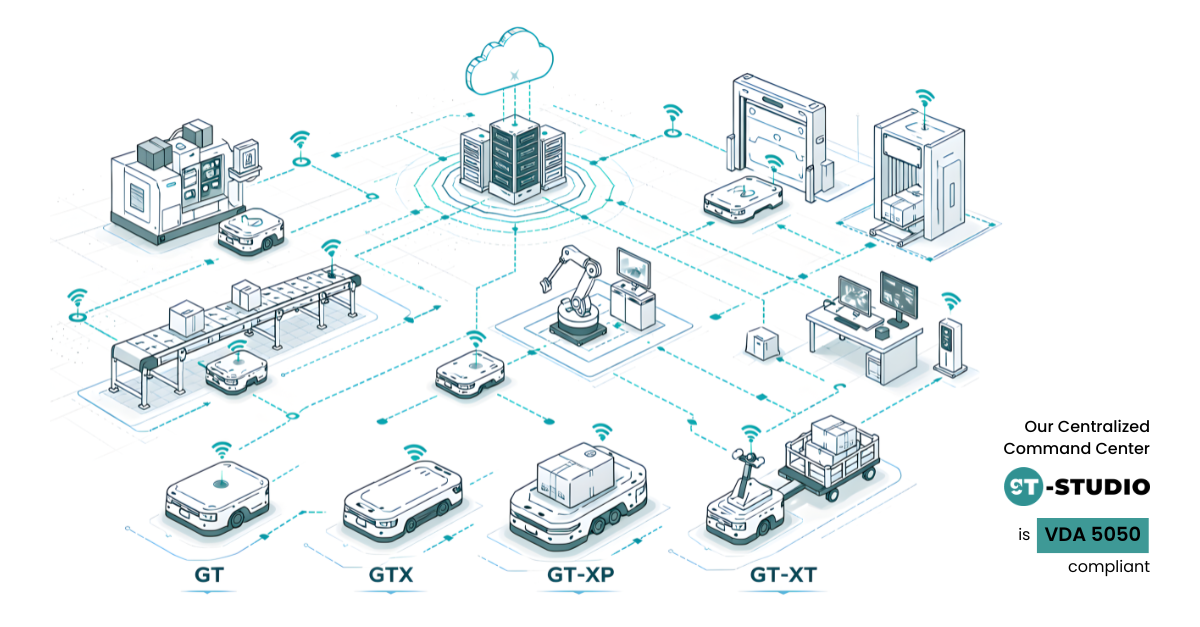
As mobile robotics deployments expand across warehouses, manufacturing plants, and multi-floor facilities, one question keeps surfacing:
Why are there so many robotics interoperability standards?
At first glance, it can appear fragmented. VDA 5050, Open-RMF, MassRobotics Interoperability Standard, proprietary APIs — the list continues to grow. But this is not an accidental duplication. It is an architectural specialization.
Robotics interoperability is not a single problem. It is a layered systems challenge. And layered systems require layered standards.
The Reality of Robotics Interoperability
Modern automation environments are no longer isolated cells of machinery. They are interconnected ecosystems composed of heterogeneous robot fleets, multiple vendors, building infrastructure systems, enterprise software platforms, and safety architectures. Each of these elements operates in a different abstraction layer.
Expecting one universal protocol to govern fleet control, cross-fleet coordination, infrastructure access, analytics integration, and hardware-level behavior would either oversimplify critical industrial requirements or result in an unmanageably complex specification.
Instead, the industry has evolved specialized standards that each address a clearly defined scope.
VDA 5050 – Fleet-Level Command & Control
VDA 5050 operates in the fleet orchestration layer. It standardizes how a fleet management system communicates with autonomous mobile robots. Orders, mission states, node transitions, and structured feedback are exchanged through a defined interface.
Its strength lies in deterministic execution. In industrial environments where reliability and repeatability are essential, VDA 5050 provides a vendor-neutral way to assign tasks and monitor progress across heterogeneous fleets.
However, it is intentionally narrow in scope. It does not govern building integration, enterprise analytics, or cross-fleet negotiation. It solves fleet-level command and control — and it does so well.
Open-RMF – Multi-Fleet & Infrastructure Coordination
Where VDA 5050 manages tasks within a fleet, Open-RMF operates at a higher coordination layer. Built on distributed systems principles, it enables multiple fleets to coexist while negotiating shared resources such as elevators, doors, and constrained pathways.
Its focus is not mission dispatching, but conflict resolution and infrastructure interaction. In environments where different robotic systems must operate within the same physical space, coordination complexity becomes the dominant challenge. Open-RMF addresses that complexity.
It does not replace fleet orchestration; it complements it.
MassRobotics Interoperability Standard (MRIS) – Monitoring & Data Sharing
The MassRobotics Interoperability Standard approaches interoperability from a different angle. It does not command robots at all. Instead, it standardizes how operational data — position, battery state, health metrics, availability — is published for external consumption.
This enables dashboards, enterprise systems, and analytics platforms to gain visibility into robotic operations without interfering in mission logic. It addresses transparency at the information layer, rather than control at the execution layer.
Again, a different problem. A different abstraction.
Vendor-Specific APIs – Performance & Differentiation
Beyond formal standards, manufacturers continue to provide proprietary APIs. This is not resistance to standardization; it is a natural outcome of innovation.
Standards typically define the common denominator. Advanced perception capabilities, fine-grained motion control, specialized safety features, and performance optimizations often extend beyond what cross-vendor standards can reasonably specify.
In real-world deployments, standardized interfaces coexist with vendor-specific extensions. This balance allows interoperability without sacrificing differentiation.
Why One Universal Robotics Standard Won’t Work
There is a well-known software engineering joke about competing standards: when too many exist, someone proposes a universal one — and the result is simply one more standard.

Image Credit: https://xkcd.com/
The humor reflects a deeper architectural truth. Adding a universal abstraction layer does not eliminate complexity; it redistributes it.
Robotics ecosystems must handle fleet orchestration, cross-fleet coordination, infrastructure integration, enterprise data exchange, safety compliance, and hardware-level optimization. These challenges exist at different system layers and require different abstractions. A single monolithic standard would either dilute functionality or become so broad that adoption would stall. Specialization is not fragmentation. It is maturity.
How to Choose the Right Robotics Standard
The more productive question is not which standard will “win,” but which problem needs solving.
Are we orchestrating tasks within a fleet?
Are we coordinating multiple fleets in shared infrastructure?
Are we publishing operational data to enterprise systems?
Are we optimizing hardware-level performance?
Each of these questions maps to a different architectural layer — and potentially a different standard. When responsibilities are clearly defined and interfaces are cleanly bounded, interoperability becomes achievable without enforcing uniformity.
FAQs on Robotics Interoperability Standards
Is VDA 5050 enough for multi-fleet coordination?
VDA 5050 enables multi-vendor robots under a single fleet manager, but it does not handle coordination between multiple independent fleets or traffic arbitration across them.
Can Open-RMF replace VDA 5050?
No. Open-RMF operates above fleet managers and coordinates multiple fleets. VDA 5050 operates between fleet managers and robots.
Does MIS control robots?
No. MIS focuses on publishing operational data such as robot status, location, and telemetry.
Are vendor APIs necessary?
Yes. Vendor APIs are typically required for hardware-specific capabilities, advanced performance tuning, and robot-specific features not covered by open standards.
Final Takeaway: Interoperability Is About Boundaries
Robotics systems are inherently layered. Control, coordination, monitoring, and differentiation exist in separate but interconnected domains. Multiple standards are a reflection of that reality.
Interoperability does not require a single universal protocol. It requires clarity about responsibilities, abstraction of layers, and well-defined system boundaries. That clarity is what enables scalable, future-proof automation across heterogeneous robotic environments.
GOAT Robotics supports VDA 5050, enabling standardized communication between fleet management systems and autonomous mobile robots. By aligning with this industry standard, GOAT Robotics helps organizations integrate multi-vendor robots more easily while maintaining flexibility to adopt higher-level coordination and monitoring frameworks as their automation infrastructure evolves.